The Classification and Definition of Elevator Types
Elevators are critical to modern architecture, and their classification extends far beyond the common passenger car. To achieve a comprehensive understanding, we categorize elevators based on their core **Drive System** (how they move), their **Application** (what they move), and specific **Design and Market Variants** (their aesthetic and budget focus). This detailed breakdown ensures coverage of every significant type.
I. Classification by Drive System (The Mechanical Foundation)
The drive system is the engine of the elevator, dictating its speed, capacity, energy efficiency, and the structural requirements of the building. Understanding these core mechanisms is fundamental to modern vertical transportation engineering.
1. Traction Elevators
Traction elevators are the most common and versatile type, used for mid-to-high-rise buildings globally. They operate using ropes or steel belts running over a sheave (pulley) powered by an electric motor. A crucial element is the **counterweight**, which balances the car's weight plus approximately 40% of the passenger load, significantly reducing the energy needed to move the car.
Geared Traction Elevators
- Mechanism: The electric motor is coupled with a **gear reducer** to turn the sheave. This gearing system provides high torque at lower speeds.
- Characteristics: Moderate speed (typically up to 500 feet per minute or 2.5 m/s), suitable for mid-rise buildings (up to 250 feet).
- Structural Requirement: Requires a dedicated **Machine Room (MR)** located directly above the hoistway to house the motor and controller.
- Pros: Highly robust, excellent for high-capacity applications like busy hospitals or industrial buildings due to their durability and lifting power.
Gearless Traction Elevators
- Mechanism: The sheave is mounted directly to the shaft of the high-speed electric motor, eliminating the gearbox. This direct connection provides smoother movement and greater efficiency.
- Characteristics: Very high speed (ranging from 1000 to over 2000 feet per minute or up to 10 m/s) and virtually **unlimited travel distance**, making them essential for super-tall skyscrapers.
- Structural Requirement: Also traditionally requires a **Machine Room (MR)** above the hoistway.
- Pros: Offer the **smoothest and quietest ride** available, are highly energy efficient (especially with regenerative drives that feed power back into the building's grid), and are synonymous with premium commercial spaces.
Machine-Room-Less (MRL) Traction Elevators
MRL technology represents one of the most significant advances in the past three decades. It re-imagines the traditional traction system to eliminate the bulky, top-mounted machine room.
- Mechanism: Utilizes smaller, permanent magnet gearless motors placed directly **within the hoistway** (usually in the overhead area). Maintenance access is provided via a small access panel at the top landing.
- Characteristics: Speed and capacity are typically comparable to geared traction, suitable for buildings up to 20 stories.
- Structural Requirement: **Eliminates the separate machine room**, resulting in significant space savings for the building owner, often freeing up valuable rooftop real estate or eliminating the need for complex structural support at the top of the building.
- Pros: Energy-efficient, space-saving, and ideal for retrofitting existing structures or for new construction where architectural height restrictions are a concern.
2. Hydraulic Elevators
Hydraulic elevators were the most common choice for low-rise applications until the late 20th century. They rely on the principle of fluid dynamics to raise and lower the car.
Hole-Type Hydraulic
- Mechanism: A piston is driven into the ground via a bore (hole) deep below the pit. The car is pushed directly upwards by the pressure of hydraulic fluid (oil) pumped into the cylinder by an electric unit.
- Characteristics: Low speed (typically limited to 150 feet per minute or 0.75 m/s) and limited to 6 or 7 stories (around 60 feet travel).
- Structural Requirement: Requires a shallow pit and a separate machine room/cabinet on the ground floor for the hydraulic pump unit and reservoir. Crucially, requires drilling a deep hole into the earth.
- Cons: Drilling is expensive and can pose environmental risks due to the underground placement of oil-filled pistons. They are also less energy efficient than modern traction systems, as they consume energy to both lift the car and compress the fluid.
Hole-less Hydraulic and Roped Hydraulic
- Hole-less: Uses telescopic pistons or pistons mounted adjacent to the hoistway walls, eliminating the need for a drilled hole. Ideal for installations where drilling is impossible due to soil conditions or bedrock.
- Roped Hydraulic: Utilizes a sheave and rope system (often a 2:1 ratio) to lift the car, where the hydraulic piston only moves half the distance of the car. This allows for greater travel distance without requiring an impractically long piston.
- Application: Both are commonly used in residential or commercial buildings where the low-rise nature and high lifting capacity are prioritized over speed.
3. Non-Traditional Drive Systems (Specialized Applications)
Pneumatic (Vacuum) Elevators
These futuristic systems use air pressure differentials, offering a unique aesthetic and minimal structural impact, making them highly popular for home retrofits.
- Mechanism: A cylindrical acrylic tube encloses the car. Powerful turbines at the top create a **vacuum** (low pressure) above the car, causing it to be "sucked" upward. A valve is used to regulate the descent, controlled by the natural movement of air pressure.
- Characteristics: Typically limited to 3 to 5 floors. Low-to-moderate capacity (1-3 passengers or under 500 lbs).
- Structural Requirement: **Requires no pit, no separate machine room, and no pre-built shaft**. The tube itself is the entire structure, allowing installation directly onto a finished floor.
- Pros: Minimal structural change, fast installation, transparent design, and highly energy-efficient on descent (gravity-assisted).
Screw-Driven (or Gear-Driven) Elevators
A highly safe and compact option often used for residential lifts and vertical platform lifts.
- Mechanism: The platform or car is moved by a powerful motor-driven **nut traveling along a fixed, threaded screw or rod**. The movement is precise and non-slip.
- Characteristics: Very low speed, excellent for low-rise, low-traffic environments. Known for their robust safety due to the inherent self-locking nature of the screw-and-nut system.
- Structural Requirement: Self-contained, with the motor often located within the shaft structure. Minimal pit (or none) and no separate machine room are required.
- Application: Perfect for retrofitting in tight spaces, such as closets or corners, and as accessibility lifts for wheelchair users (Vertical Platform Lifts).
II. Classification by Application (The Functional Use)
The intended use of an elevator dictates its size, speed profile, load rating, and specific operational features.
| Elevator Type |
Primary Use & Context |
Key Specifications & Features |
| Passenger Elevators |
Moving people in residential towers, offices, hotels, and public buildings. They are the standard vertical mobility solution. |
Speed is proportional to building height (e.g., high-speed gearless for 30+ floors). Focus on ride comfort, aesthetics, and smooth floor-to-floor transitions. |
| Freight/Cargo Elevators |
Moving goods, industrial equipment, vehicles (car elevators), or extremely heavy loads in warehouses, factories, and parking garages. |
High capacity (often measured in tonnes), rugged, non-decorative interiors, diamond-plate steel floors, and extra-wide/tall doors. Often use hydraulic systems for their high lifting power. |
| Service/Hospital Elevators |
Designed specifically for healthcare and service industries: moving patient beds, medical equipment, and large service carts. |
Extra-wide and deep cars (to accommodate a bed and staff), smooth ride stability (critical for sensitive equipment/patients), and specialized controls like "Fireman's Service" and "Hospital Emergency Recall." |
| Dumbwaiters |
Transporting small items (food, laundry, books) between floors in restaurants, homes, or multi-level libraries. |
Very small car size (no stand-up room), low capacity (typically under 200 lbs), and no passenger controls inside the car. Operation is only from the landing doors. |
| Vertical Platform Lifts (VPLs) |
Accessibility solution for wheelchair users needing to travel a short vertical distance, such as onto a porch or between two floors. |
Limited travel distance (typically max 14 feet). Often use a simple screw-driven system with "constant pressure" (hold-to-run) controls for maximum safety. |
III. Classification by Design & Market Variant (Aesthetic and Budget)
These categories overlap the mechanical systems, defining the aesthetic, luxury level, and target market for the elevator installation.
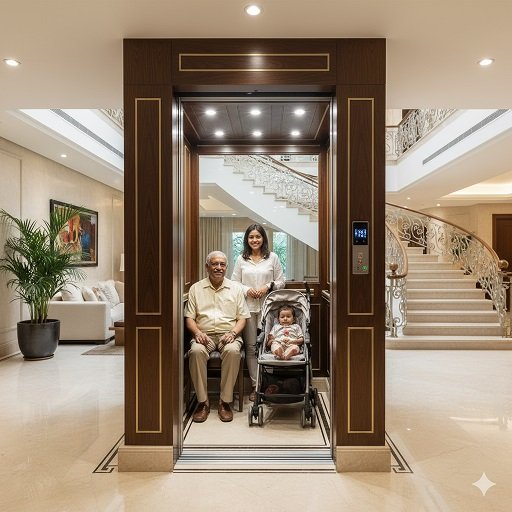
1. Home Elevators (Residential Lifts)
These are tailored for private residences, where space, minimal structural change, and quiet operation are paramount. They prioritize safety for the elderly and disabled.
- Design Constraints: Must fit within small existing spaces (often a closet or a corner of a room) with minimal headroom and pit depth.
- Common Mechanisms: Dominated by **Screw-Driven**, **Pneumatic Vacuum**, and compact **Roped Hydraulic** systems due to their self-contained, MRL designs.
- Customization: Focus on residential aesthetics—often featuring decorative wood paneling, brass fixtures, and accordion or lattice gates that match interior home decor.
- Safety Feature Focus: High emphasis on slow, smooth starts/stops, emergency battery lowering (ARD), and intuitive, simple controls suitable for all ages.
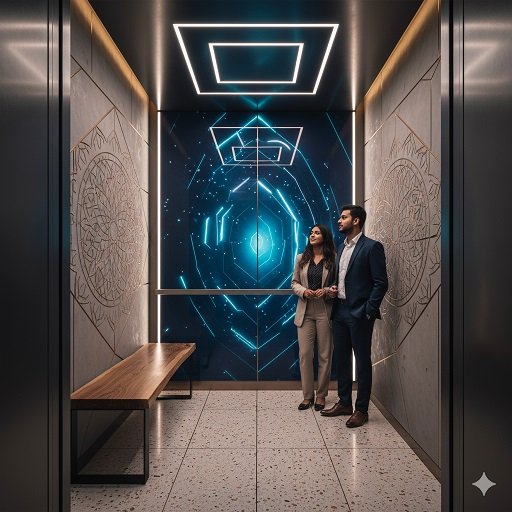
2. Luxury Elevators
The pinnacle of elevator design, prioritizing bespoke craftsmanship, premium materials, and cutting-edge technology over cost.
- Design & Materials: Unrestricted customization. Finishes include exotic materials such as hand-etched glass, marble or granite flooring, leather-wrapped handrails, and bespoke metal plating (polished brass, rose gold, or bronze).
- Aesthetics: Often utilize **Panoramic Glass Shafts** for an open, integrated feel, or employ custom shapes like circular or semi-circular cabs. Lighting is dynamic and ambient, often changing color or intensity to set a mood.
- Technology: Integrated with smart home systems, featuring voice-activated controls, personalized user profiles, and sophisticated destination dispatch interfaces (touchscreens). The ride is achieved via Gearless Traction for unmatched smoothness.
- The Experience: The goal is to make the ride a feature of the building, not just a means of transport. Every component is meticulously engineered for silent, vibration-free operation.
3. Style Variant Elevators
These are defined by their commitment to a specific architectural or interior design theme.
- Modern/Minimalist: Defined by **clean lines, flush surfaces**, and monochromatic schemes. They often feature stainless steel hairline finishes, hidden control panels, and frameless glass doors. The car is designed to be a seamless, subtle part of the wall.
- Classic/Traditional: Uses rich, dark woods (mahogany, cherry), decorative moldings, ornate brass fixtures, and ceiling chandeliers. The intent is to match the aesthetic of classic European or heritage architecture.
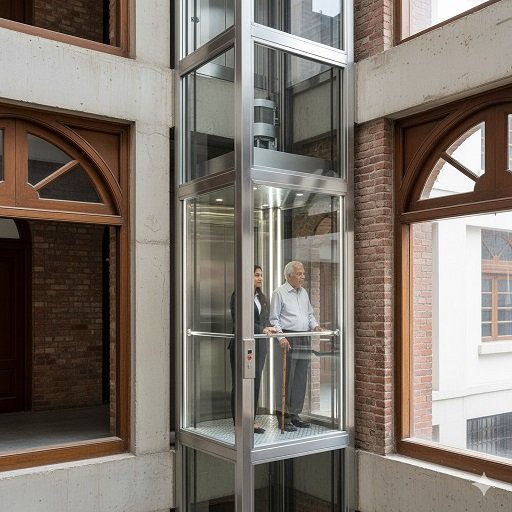
- Industrial/Loft: Embraces raw, exposed materials. Features include perforated metal panels, black matte trims, exposed fasteners, and often a glass shaft that explicitly showcases the industrial mechanics of the lifting system.
- Panoramic/Scenic: The style is defined by transparency. These are often used in malls, hotels, or exterior building walls. They feature **full-glass car walls** and sometimes a structural glass shaft to maximize the visual experience for the passenger.
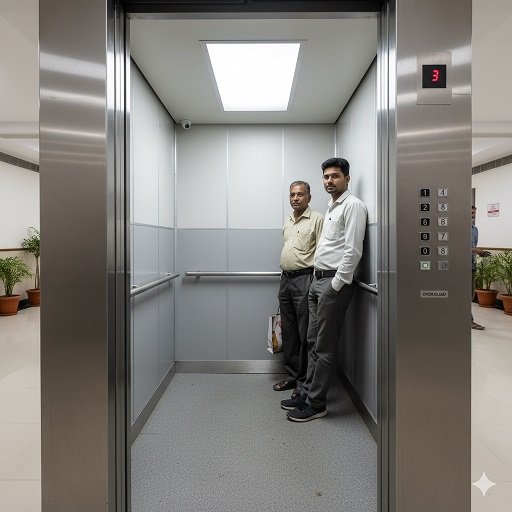
4. Comfort / Budget Variant Elevators
These are the value-engineered options, focusing on functional reliability, compliance, and minimized long-term operational costs.
- Cost-Effective Design: Utilizes standard, durable, and easily sourced materials: powder-coated steel panels, basic laminate flooring, and robust but simple control fixtures. Materials are chosen for durability and ease of cleaning over luxury.
- Ride Comfort: Comfort is defined by reliability and a basic, smooth ride achieved through a well-maintained Hydraulic or standard Geared Traction system. Focus is on quick and inexpensive fixes.
- Technology: Features basic tactile push-buttons, simple LED or segment displays, and standard safety systems. Advanced features like destination dispatch or smart controls are absent to keep costs low.
- Application: High-traffic, non-premium environments like student housing, standard apartment complexes, or small corporate offices where budget is the primary driver.
IV. Advanced Structural and Safety Craft
Beyond standard types, innovations in structure and safety define the future of elevator technology.
Structure / Craft Innovations
- Double-Deck Elevators: A critical structural solution for super-tall buildings. It consists of **two elevator cars stacked and moving simultaneously** within a single hoistway. The upper car serves all even floors, and the lower car serves all odd floors, effectively doubling the passenger handling capacity of a single shaft.
- TWIN System: A radical engineering breakthrough where **two entirely independent elevator cars** operate within a single hoistway. Each car has its own drive, ropes, and counterweight, using an intelligent traffic control system to maintain a safe separation distance. This maximizes vertical efficiency in a dense building footprint.
- Cable-Free (Linear Motor/MAGLEV) Elevators: The most significant structural shift since the counterweight. These systems use linear electric motors to propel the car along the rails without the need for traditional ropes. This allows the car to move **horizontally** as well as vertically, opening up new architectural possibilities and eliminating the height limitations imposed by steel cables.
Universal Safety Standards
Regardless of type, all modern passenger elevators are mandated to adhere to strict safety features to ensure public trust and operational security.
- Safety Gear (The Gripper): A mechanical braking system that is triggered by the overspeed governor. If the car exceeds a safe speed, the governor causes the safety gear to clamp the car onto the guide rails, preventing free-fall.
- Automatic Rescue Device (ARD): A crucial battery-powered system. In the event of a power outage, the ARD engages, providing just enough power to safely move the car to the nearest floor and open the doors, allowing passengers to evacuate.
- Buffers: Located at the bottom of the pit, these are shock-absorbing devices (either spring-type for low speeds or oil-type for high speeds) designed to gently decelerate a car in the unlikely event of a slight over-travel at the bottom landing.
- Door Interlocks: A series of mechanical and electrical safeguards that ensure the car cannot move unless all shaft and car doors are fully closed and locked. Similarly, the shaft door cannot be unlocked until the car is perfectly level at the landing.
The complexity of elevator technology reflects the demands of modern buildings. From the silent, energy-efficient gearless motor of a skyscraper to the compact screw drive in a private home, each type is a specialized solution to the challenge of vertical mobility.
📞 **Ready to Install Your Perfect Lift?** Call or WhatsApp us directly: 8300860659